Shamir
Is there so much conflict about this place because it’s special, or is this place special because there’s so much conflict?
My journey begins rough. Two buff man in perfect suits stop me at the check-in line at the airport and escort me to a windowless room somewhere in the dark belly of the monstrous building that we use to explore new worlds. I’ve spent the last four years in rural eastern crete, surrounded by nature and animals and a handful of carefully selected beautiful souls. The people there are simple and unbothered, the only guns I see are historic rifles from the pre-war-era that Costas busts out after a Raki too much and the police prefers drinking coffee over making problems. The only conflicts i encountered were in myself. Now I’m suddenly exposed to and at the mercy of two highly trained, violent man who are here to intimidate me. „How do you make your money?“ „Why do you go to Israel?“ „Where do your parents live?“ „How do you make your money?“ are a few of the ever repeating questions I have to answer like a machine gun for about 10 minutes before the two gentleman want to search my personal phone. They want to see my social media which I don’t have. Instead they open whatsapp and go through my chats, read conversations with my mother. In another chat is a nude picture of a woman who trusts me. They open it on fullscreen and zoom in on a tattoo. Apparently I passed whatever test this was, they suddenly get up, bring me back to the check-in counter and personally give me my boarding pass. I’m done with the interrogation but not with the intimidation. For the remaining two hours until boarding I get a babysitter who stays at my side wherever I go, even to the toilet. I prepared myself for this, I knew it could happen but the actual experience was much more raw then I expected. I felt powerless and humiliated, probably the emotions the whole process was designed to make me feel but why? I’m not sure.
Everyone at the immigration in Tel Aviv is very friendly, but they make me wait another hour without my passport before an officer comes and hands me an entry permit. Leaving the airport I immediately feel that something is in the air that I haven’t felt before. Im an experienced traveller, what i feel here in israel goes beyond the curious, innocent excitement that explorers feel when arriving in a new world. It also goes beyond the asocial anonymity that all cities demand to a degree, where a lot of people are so overstimulated they avoid interactions and eye contact is uncomfortable. Is it really the holy land I wonder. I’m a convinced agnostic who only very recently had some spiritual experiences that I try not to loose myself in. Instead I try to see and hear what is around me. Israeli flags everywhere, big posters in hebrew, presumably about the hostages still left in Gaza, stickers on every public surface commemorating fallen and kidnapped soldiers, with pictures and praising words about their heroism. And, most notably, smoking teenagers in short pants and civilian clothing carrying automatic rifles. How casually the people here surround themselves with weapons of war makes it feel like the war is normalised. Not this specific one as an individual event but war as a concept, as a transcending state of mind is rooted in the israeli society. The people don’t seem particularly nervous or stressed, they are curious about me, probably because I radiate the excitement of a foreigner in a strange place. A nice lady on the train lets me charge my phone and is happy to tell me about her Israel. The contrast of people behaving absolutely as expected while completely surrounded by symbols of war is bewildering to me. Later on my trip left-wing Israelis will argue that there are protests against the war every day and far left-wing Israelis will counter that they only protest their own suffering and not also that of the palestinians. Or rather that of the arabs as the ‚p-word‘ is banned by unwritten laws in Israel and can only be whispered. The subhumans Gallant spoke about don’t deserve an identity.
Why do I even care about this, you may ask. And you would be right, there is gruesome conflict and endless suffering in many places around the world but I don’t travel there or write long blogs about it. Allow me a few words about my background so you may understand my perception. As a german I have a special connection to Israel as the jewish state. Every year of my 12 year education i have spent learning about the unspeakable crimes of my almost direct forebears. 12 years of gas chambers, extermination camps and Mengeles experiments hammered into my developing brain but never, not once in any of the four schools I went to, was I brought in contact with actual jewish or israeli life.What I was in contact with is muslim arabs. I grew up with them, their culture is the ‚cool one‘ as it tends to be the case for marginalised groups. Their woman are the most hard to get and therefore naturally the most interesting. My political upbringing was with arab groups who made the palestinian case a central part of their identity. On the one hand we german kids have the forced, constant teachings about death disaster and guilt from an institution as boring and repelling as school, on the other hand we have the cool, rebellious and energetic arab culture with its ideas about Israel and Palestine. It was only when I came to Crete that I experienced israeli life as opposed to jewish death. That I was welcomed so warmly, so full of love and without any kind of accusation warmed my heart and I want to say healed something in me. It has put me in the position of an outsider having deep personal connections to both worlds, knowing the suffering of both sides.
I picked up a car in Kiryat Motzkin on April 11, the first day of Pessach, the most important jewish holiday. The streets were empty, the city a ghost town and I ran to find some food. What I found was an example for the israeli misperception of themselves. Two very friendly shop owners praising schnitzel as one of the famous israeli dishes. The name evidently not being hebrew doesn’t stop many israelis from deeply believing this and other small lies they feed themselves, presumably to deepen a cultural identity. The rest of the world sees it as cultural appropriation. The austrians might not care about their schnitzel (publicly) but morocans want to keep their Shakshuka, the turks their Schawarma and the arabs their word yallah. Especially In a time when the world (falsely) accuses Israel of genocide, this feels ignorant.
I was warned about the israeli drivers but I made my roughly 90 minute trip to the galilee panhandle without any problems. I will stay with a friend for the first three nights in Shamir, a Kibbutz less then 10 kilometres from the lebanese border. Roughly four months after the cessation of active hostilities a harrowing feeling. Shamir, a Kibbutz of about 1000 people, established by northern european jews, is a place that feels like it fell out of time and space. The landscape on the way is nothing short of breathtaking, passing the Sea of Galilee framed by mountains, entering the flatlands north of it, green and vivid and alive, Israel is doing a great job preserving its nature and wildlife. Entering Shamir is a rollercoaster of emotions. The landscaping is famous in all of Israel, the perfect embeddement of infrastructure into nature. A blossoming place full of flowers, old trees, birds, badgers and porcupines. Every corner is promising, every turn exciting. It is very clean and structured, with respect for nature. Paradise one might say. But someone has to open the gate for me to drive in, the periodic beeping of the smart security fence surrounding the kibbutz is a constant reminder of fear and bunkers with shooting wholes are placed at sensitive strategic points. The people are polite but closed off and reserved. Taking a night time stroll, I’m suddenly made aware why that might be: Lebanon. Located at the foot of the Golan, Shamir offers an amazing view over the valley and the surrounding hills, including lebanese villages. The enemy is in sight, constantly, all the time. People who would kill every single soul in this kibbutz are in sight. Hezbollah might not have a chance to physically kill anymore, but their omnipresence in everyone’s mind seems to do that job just as well.
Later this night I sit on my porch smoking a joint, weed is decriminalised and its use widely accepted in Israel, as I notice a symbol of what makes this place so strange. The people don’t greet each other. Very uncommon for such a small community. That together with the fact that everyone drives around in golf carts and is very mindful about sticking to the rules and laws all the time, written and unwritten, rational and irrational makes this place feel fake. Beautiful but soulless. As another golf cart drives past, ignoring my shalom, I can’t help but have the fallout jingle play in my head. This place feels dystopian. I’m wondering if the people here cling so desperate to their perfect world because they feel the presence of a lethal enemy and deep inside they know it can all collapse at any given moment.
The next day and i visit the eastern shores of the Sea of Galilee. This side is less populated, more natural. It’s the first biblical place I visit and even though my disgust for religion is strong and steady, there’s an unspecified, tingly feeling in my chest. Religion and pop-culture get deep inside all of us and there’s nothing we can do about it. As the explorer I am I don’t like to get recommendations about places to go to or, god beware, look them up online. I park the car on an elevated lookout next to the highway, some 100 meters from shore. To the north is a large, busy camping ground, not very appealing, but behind it is a promising piece of green and a seductive curve in shoreline. I decide to go for it, turn to the street and want to start walking as I remember it’s a highway – no sidewalk. I’m stubborn and really don’t want to waste time to move the car again so I take a closer look at the slope in front of me. Pretty steep, a mix of rocks and sand and no paths, not even of animal origin. Not easy but doable and I’m confident in my body so I begin my decline. After the first careful meters I turn around and notice how the people on the lookout stare at me. They are really not used to someone behaving out of the norm. I think another expression of the obedience this part of the world demands is the relative absence of punk and anarchist culture. I conclude my way down successfully, past some slippery bits and a bundle of old, rusty barbed wire that I narrowly avoid and find myself at the beginning of a flat field with dense, hip-high vegetation that I have to cross before reaching a walking path by the shoreline. I briefly think of snakes and scorpions but since a snakebite at such a biblical place would also have something poetic I trust my luck and go for it. The camping ground is larger then I thought and as i’m greeted by a big greenhouselike structure at the end of it, I begin to question my decision. But I still have the seductive curve in shoreline close ahead of me so I take the overgrown path behind the greenhouse and keep heading north.
Following my intuition is, like almost always, the best decision and I’m rewarded with a beautiful hiking trail. Large, dense vegetation to both sides of the path, creating the feeling of a natural tunnel. The water is just behind it to my left, to the right is no man’s land. Almost no signs of human interference and most amazingly, I’m completely alone. Countless animals announce my arrival and after some minutes on the trail something large not far from me in the bushes expresses its unhappiness about my presence. Not so alone, but this is company I enjoy while being in nature and my feet want to keep going. I walk the trail for about an hour, lost in the beauty, peace and my thoughts as a fox is running towards me. We both stop, look at each other for a split second before he makes a run for it to the bushes. A few meters later I’m suddenly made aware what he was running away from. A wild boar standing on the path, staring me down, about 30 meters ahead of me. I look left and right, the vegetation is large and dense but mostly thin, a lot of bamboo and bushes, nothing to climb on. In the moment that I realise I might have a serious problem the pig grunts, turns around and decides for flight instead of fight. I take a deep breath, give it a few moments and cautiously walk on. Reaching the spot where the boar was standing my instincts kick in and I turn around in the spot. Piglets. My luck in all honour but a mothers protective instincts are maybe the strongest drive in this world and a boar can do serious damage. My heart is jumping in my chest as I move away and my ears frantically search for 80 kilograms pure force on hooves charging at me, but mama pig has luckily made the correct assessment of me not being a threat. I weigh my options. Walking on now is clearly not one and walking back the same trail for about an hour is against my nature, as my eyes fall on an opening in the bushes towards the water. I take it and reach an area vaguely resembling mangroves. Something feels weird here, unnatural. A friend will tell me later that the shoreline has drastically retreated in the last years. The planet is dying, even here. A single tree stands out, full of herons taking a rest on their long migration north, who are not really bothered by me. The way ahead is blocked by a five meter stream which I could swim, but the other side only offers thorny bushes. I decide to wait, smoke a cigarette and give Mama pig enough time to bring her babies to safety. There are hooveprints in the mud everywhere and I’m not really comfortable, but at least I have the tree with the friendly herons to climb on in case need arises. Moving ahead carefully I slowly reach the end of the trail, the natural tunnel has made space to more open fields with knee-high grass to both sides as I indeed meet mama pig again. Not on the path this time, but closer, about 15 meters away. We look at each other, she’s aware but not threatening and I avoid eye contact, trust in my ears to detect any signs of impending doom and keep walking. She lets me pass. The respect the Israelis show to nature seems to be acknowledged and rewarded by its animals. Interestingly a lot of my israeli friends tell me about their government’s and fellow peoples failure to protect nature. If they would only know how the greeks treat their lands. As always, it’s a matter of perspective.
This evening I will attend the first seder night, an important jewish holiday, in Shamir. It’s my first kibbutz gathering and I’m very excited. In my dedication to honesty with you, dear readers, I have to tell you that an event occurred that day which made me very sad. It’s personal and I don’t want to elaborate but it probably influenced how I experienced this evening and also the next day which i spent in the same environment.
The ceremony starts at 7:15 and people are on time. Not very Israeli but very Shamir. Long tables are set up in a large hall. Food waiting in thermo-boxes to stay warm, water and grapejuice for the kids. No alcohol, but people bring it by themselves and there’s a stage with music instruments. It reminds me a bit of a nursing home. Every chair has a handheld sign on it with a different cartoon symbol and I begin to worry about some kind of group activity, which luckily doesn’t manifest. The ceremony is long, religious and in hebrew. My friend who’s supposed to translate disguises religion with almost the same passion as me and is too bored and repelled to do a good job. I’m pretty lost in my sadness for some time until the band starts playing. I think to finally recognise a rebellious soul among the people here, the guitarist and I focus on his energy. Something amazing happens during the last song. It’s a strong, energetic piece, freely translated to ‚One Good’ and the whole room suddenly wakes up as one big united being. I see shy kids jumping around and ancient, grumpy grandpas who do nothing anymore except waiting for the sweet relief of death, raising their fists and scream the lyrics with the power of a teenager pursuing their first love interest. It’s very beautiful, a glimpse of the strong unity Israel creates. It’s an excluding unity though, one for which they pay a high price. It’s of course also an example for the terrible power and control religion and its institutions can execute over people, but in this moment which touches me deeply I don’t care. The song also marks the end of the evening and I get to experience another beautiful happening. Nobody just leaves, instead we all clean the tables together. Nobody asked for that or had to remind anyone. 1000 people all bringing dishes to the small kitchen is not an orderly process. Something chaotic naturally occurring in a place like Shamir makes me happy. Even in my dark state of mind, a glimpse of hope.
The next morning begins with my friend bringing me coffee, her amazing dog Bruno to love on and wise words. Afterwards she does the only right thing with me that you can do when you find yourself in a whole: stop digging and start moving. Israelis are symbolic people so she sits me in the car and drives me to the Golan. Ruins of ancient castles next to rough rock formations and wide fields of green grass. The Golan is a beautiful world of itself, lord of the rings vibes. We arrive in Majdal Shams, a druze village pretty much directly on the border with Syria. Border is a fluid term in this area though. Little reminds of the active military operation just on the other side of this very mountain where a more or less quiet landgrab is happening. Only a small group of israeli soldiers, armed of course, standing in front of a shop. But they are such a common sight in Israel, even for me on day three, already somewhat normalised. Little reminds of the tragedy that happened here last year during the active hostilities, when an impact killed 12 kids while playing football. Unclear if it was a Hezbollah rocket or an israeli interceptor missile. The druze here consider themselves Syrian, but I don’t feel any resentments towards me or my friend. We enter a restaurant and order typical local cuisine. The hospitality is warm and the food absolutely delicious but here I get in touch with another big israeli problem. In my parts of the world this meal would be considered fast food, would cost me 15€ in Germany and 20€ in Greece. Here i paid 60€. The prices in Israel are completely out of touch with its peoples capabilities. Later on my trip I want to buy socks in decathlon, but the cheapest pair I find is 10€. I hear from many beautiful israeli minds who love their home and are desperately needed here, that the prices are pushing them towards emigration.
On Crete I swim in the sea everyday and I begin to miss it. As a true german I’m a big fan of the nudist culture and being naked in the water became almost a necessity for me. My friend offers to take me to a secret spot at the Banjas river down in the valley, but warns me about its freezing temperatures – perfect. The way has me in awe of the natural beauty again, we reach her spot through an old forest with free roaming cows and a short adventure hike through mud and bushes. The swim has me refreshed and in good spirits, ready for a special experience that will leave an impact on me.
Another friend takes me to Metulla, an israeli village directly on the border with lebanon. The villagers were evacuated during the last round of fighting and are only slowly returning. We drive through a cute, sleepy, half abandoned village before we suddenly reach the fence that marks the border. In my expectations this was an archaic place with tanks, nervous border guards and lots of technology, but nothing. Just a fence with a gate, pretty much like you would find it in any sleepy village anywhere in the world – just a bit bigger to fit the tanks. Israel reminds its people everywhere in the country all the time about the war and enemy. But here where it’s actually happening, similar to Majdar Shams, it’s hiding its activities. We drive up to a lookout and here I notice the wounds of war. Heavy military vehicles have damaged the road, the way farer up is blocked, leading to a military base from which I hear the deep, dark grumbling of some kind of large machine. The lookout is like most israeli infrastructure beautiful and welcoming, two soldiers sitting on a bench, their rifles carelessly layed down, enjoying a break. We have a breathtaking view over the valley, the Golan and Lebanon. The area between the border and the first lebanese villages is a one kilometer wide empty zone with some israeli technology, early warning systems. My friend calls it no man’s land. I have seen no impacts or damaged buildings in Metulla but my friend points to a completely destroyed lebanese village, eradicated until the foundation. Feeling how deeply disturbed the israelis here are, with all their advanced technology and protective infrastructure, I can only imagine how the lebanese feel, knowing their enemy is from the future. It doesn’t matter who started it or who has done or is doing what or when – all that matters is that it ends.
I ask Israelis why they are here, in this place that extracts such a high price from themselves and others, they tell me they need to defend their homeland. Nationalism is not an organic feeling in us humans, many elucidated people around the world including myself don’t have it at all. The thought of Hamburg, my hometown, being danish or french or russian couldn’t bother me less. Israeli nationalism is partly shaped by the Shoah, on which I as a german don’t have the right to express an opinion. Apart from that it is shaped by decades of strong propaganda, since at least some years with a racist, supremacist and fascist touch and religion. Israel is the only advanced country where religion still plays a role in the progressive parts of society and that’s a problem. It’s a tool to control people and separate them from each other. A liberal friend of mine tells me he wouldn’t choose a partner that is not jewish. Bewildering to me. Diversity, learning from the experience of other people, is progress. To break the cycle of hate, we must break the artificial cycles in ourselves.
Jerusalem
Jerusalem! The name of the city we all soaked up with our mothers milk. Embedded in our history, mythology, religion, pop-culture. I’ve seen a million movies portraying Jerusalem as the ultimate object of desire, heard the name in a billion songs, played the game trip to Jerusalem. I think I’ve rarely ever been so curious about a place. The way there leads through a different world though. Hostile territory, at least in my israeli car. The E90, connecting Israel’s very north with its very south cuts, through the West Bank. My anxious friends warn me about this route, the confident ones say it’s probably fine and I really want to see palestinian life.
A few kilometres before the West Bank I’m being drawn to a nature reserve a friend recommended. The Kibbutzim Stream is yet another example of Israel’s near perfection in bringing people and nature together. A narrow, curvy path leads along the water, mostly hidden from my eyes through trees and a dense line of tall, dreamy reed. Gentle infrastructure gives access to the stream every few hundred meters. A small wooden platform here, stairs made from natural stones leading into the water there. All perfectly maintained and even though it’s a touristic place there’s no trash anywhere. The colour of the water is of light blue and crystal clear, full of fish of all sizes. I sit down on the stairs to read for a while, my feet in the water and small fish come to nibble on them. Garden Eden comes to mind and I have to laugh about my brain spitting out a biblical reference. My only problem is it’s Pessach and the place is packed, I don’t see a chance to swim nude. But a nice israeli lady walking her dog finds my searching eyes, offers help and shows me a suitable place. The israelis have a beautiful way to interact with friendly souls.
I am filled with this emotion as I pass a military checkpoint and enter not only a different world but a different universe. It’s not just a feeling but visible, the colours have changed. Just now I’ve been to this lush, green oasis, now everything is dry and brown. The guardian says Israel controls 80% of the water reserves in the West Bank, an Israeli uses four times more water per day then a West-Bank-Palestinian has available. Which is 20 litres by the way, for everything, including farming. Those numbers are from before the last round of fighting. Even my confident friends have firmly warned me from leaving the highway but even if I wanted to, my options are limited. Several lines of different fences have the road in a chokehold. Or maybe it’s the road with its fences having the surrounding land in a chokehold. As always, a matter of perspective. What i see is overwhelming misery and poverty. Rusty, gutted cars next to housing structures that maybe deserve the word shacks. It reminds me of the townships in Cape Town, or the slums around Jakarta. Being inside the fence makes me feel like a visitor in a zoo and I’m disgusted by myself. Several Israelis, including enlightened, educated people who i know have a good heart will tell me that the islamic culture is backwards and the arabs are savages. They might be right. But we europeans were exactly the same just 100 years ago and have since then been bombing the arab world into oblivion. We must create an environment in which they can develop just like we did. Almost all Israelis I know have lost their Utopia and i can understand why. But I firmly believe they must find it again, urgently. History tends to repeat itself and its full of David-vs-Goliath-Stories.
I pass another checkpoint and am finally here: Jerusalem. If I would have hoped for some kind of religious awakening, the holy ghost suddenly jumping out of the sewer into my veins, I would have been disappointed. It is possible though that i just didn’t notice him because i really have to focus on the road. Eight lanes diverting all the time into tunnels, bridges and who knows what, my gps desperately trying to keep up. I have to find my way to En Kerem, a historic neighbourhood on the outskirts of Jerusalem. In all fairness, pretty much everything here has something historic about it. I park the car and am stunned. They call En Kerem a village in the city and that is spot on. Located on a slope, surrounded by a forest belt, a few high rise building blocks but mostly old, cute houses with gardens, built chaotically, without the brutal, cold precision of modern city planning. A number of famous churches and countless tiny, promising alleys – an explorers dream. I have two hours before i’m supposed to meet my host, three in Israeli time, so I start walking. My first stop is in a café, where I drink a 7€ cappuccino and watch the people. They are young, artsy and communicative. A maybe eight year old boy comes to me, is not scared as he realises he has to speak english and asks for some kind of donation. I give him a few Shekel and a compliment for his english. He proudly runs back to his parents who gift me a warm smile. Even though the area is clearly very rich, it is not closed off or elitist, I feel welcome. I let my feet lead the way which take me up the slope through tiny alleys past art galleries, dreamy backyards and churches from the time of the crusades. I reach some kind of square in front of one of the high rise blocks and try to catch my breath as a big dog is charging at me. He has a leash attached to his collar but on the other end of it is nothing. He corners me, growling, baring teeth and lunging. I have enough experience with dogs to know he’s only bluffing – probably. I stay calm, pretend to not notice him and look around for where the hell the owner is. We are at a stalemate for a minute that feels like an hour before someone comes running, grabs the dog and walks away without a word to me. I stare at his back for a moment, shake my head and walk on as two Israelis come to compliment my bravery and smartness. Shortly after a car with a man inside stops next to me, tells me this dog has been attacking people, offers to drive me out of here and recommends to call the police. He shakes my hand as I decline both. The Israeli care for one another is heartwarming and not experienced everywhere in the world.
It’s time to meet my host, the mother of a friend of a friend. She opens her marvellous house to me, built in the rock with arches, curved ceilings and a million beautiful details. We have a connection, almost immediately dive into conversation about philosophy and walk to a nearby restaurant for dinner. She recently took some hard hits from fate and over the next few days I will help in the house, roll her joints and support her on adventure walks. In return she offers hospitality, the infinite wisdom of someone who lived life without abandoning their dreams and ideals and lets me experience parts of her truly inspiring soul. Quoting the Beatles she came like mother mary to whisper the words of wisdom i really needed to hear: let it be.
The next morning and I want to take the bus to the old city. In Jerusalem it’s not possible to buy a ticket in the bus. You have to use an app, which I briefly tried but didn’t work for me, or you can buy a rechargable card at small shops around the city. The one I put my hopes in is unfortunately closed so I ask an elderly gentleman at the bus stop what I could do. He signals me in broken english that he will take care of it, I shall just follow him and we begin to talk. He asks for my religion to which I give the honest reply, none. His face takes a new impression, he looks deeps into my eyes and says with the shrieking voice of old age: ‚You are different.‘ I am flattered and the people of Jerusalem like themselves in this role. We enter the bus, grandpa taps his card on a device and tells me with a cheeky smile that it’s fine, only three stations. I like that this ancient creature pushes me to commit a criminal offence and reciprocate the smile of the conspirators. We get off the bus, he insists to bring me to the machine that will spit out my bus card, pays for it as it doesn’t want to accept my credit card and gives me three cigarettes. I look after him as he waddles away, not really sure what just happened and smile to myself processing this nonconforming experience.
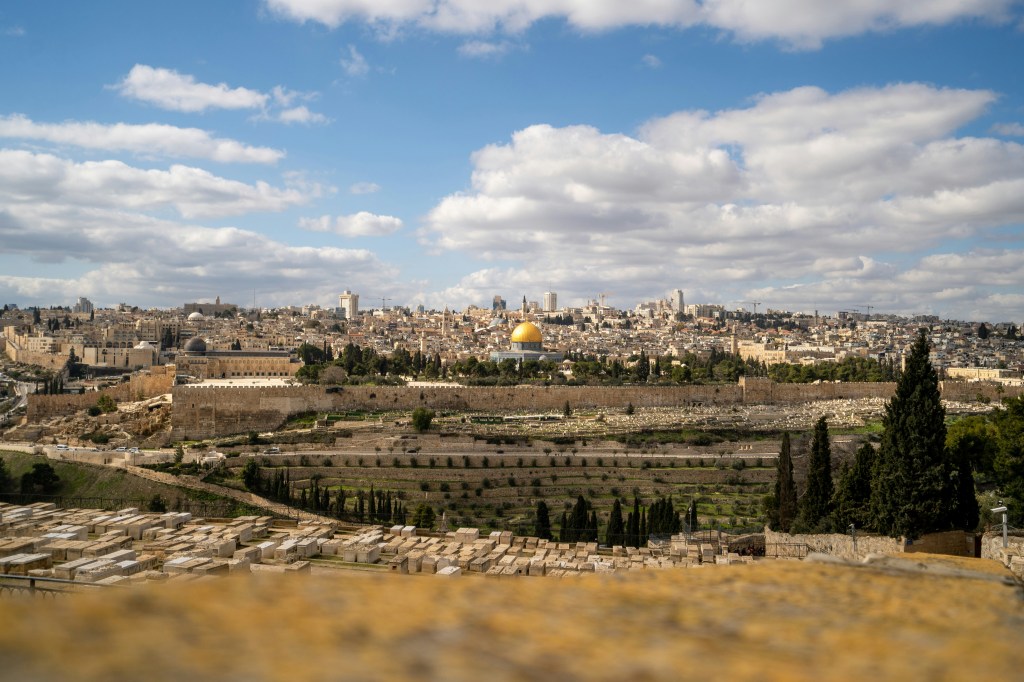
As I leave the tram near the old city I’m being swept away by a wave of people, all streaming to the distant monumental walls that promise redemption to so many. I let myself flow with the mass and try to find some kind of pilgrimatic feeling inside me. But even as part of this large mass of people all moving with the same goal, creating somewhat of a swarm dynamic – apart from my usual curiosity and excitement about a new place there’s nothing. Except an underlying anxiety, a constant subconscious readiness to fight or flee – there are heavily armed soldiers and military vehicles absolutely everywhere. We pass the tower of David, I notice an open door on top of a short stairs and I exit the swarm to take a closer look. It is clearly not an official entrance but there are no signs prohibiting entry and I take the open door as an invitation. I pass a small yard and are about to open a second door to the actual tower as a security guard behind me expresses disapproval. He is not mad at me, judging by the look of guilt on his face he should not have abandoned his post and he escorts me out gently. Worth a try. Back in the swarm and we slowly move towards the western wall. There’s a jewish ceremony in progress, loudspeakers blast religious singing through the alleys and as we reach the big square it’s absolutely packed. To enter I must go through security and have my backpack x-rayed. There are seperate entrances for man and woman, talk about backwards. I make my way to the very end of the square where I have at least a little room to breath and try to soak the energy of the place, but I’m just uncomfortable. I leave and climb on a wall from where i have a view to the east. I have to look twice and still actively trust my eyes. Graves. Thousands of graves wherever I look and now I feel something different. The ground is soaked in blood. Thousands of years of conflict, the suffering and death of millions have shaped this place and I can feel it. Definetely special, but as far away from holy as it possibly can be, at least for me.
My feet find the way to the palestinian part of the old city. Almost no tourists come to Israel in these times and it’s pretty empty, I love it. Shop owners and streetsellers lay their hopeful eyes on me as I wander through the labyrinth of narrow alleys and tunnels. Smoking grandpas with warm, knowing eyes feed their birds they keep in little cages everywhere, workers with handcarts rush past me, I feel a bit like I time travelled. The few women I see all wear hijab, but are not shy to interact, or reluctant to talk to me. Groups of soldiers everywhere of course, armed with their obligatory automatic rifles. I wonder, in case of an attack in these narrow, closed spaces, would it even make sense to use a long rifle or is this just part of the show? I want to see the Al-Aqsa-Mosque and try to pass a gate entering its yard, but a soldier stops me, asks where I’m from and if I’m a muslim. He denies entry to me as I say i’m not. Heading out I see a sign ‚We invite you to explore Islam‘ and I wonder on whose order the soldiers turned me around. I leave the old city to the east, find myself in a lively palestinian neighbourhood and sit down in a café to write for some time. The sun is shining, the people are happy to see me, but mostly leave me alone as they notice i’m in my own world. I think about how beautiful but suffocating Shamir was as two young man on horses gallop down the main road, past honking cars and blinking advertisements. I see the unchained joy in their eyes and I realise, this type of uncontrolled, wild freedom is missing in many israelis I meet. Beautiful infrastructure, advanced technology and good roads are one thing, but a free soul is another.
I spent the evening on the couch with my host, sharing joints, music and conversation. She allows me to puke my heart out and shares some of her own pain. Tells me about her grandfather who came to Israel and built the first synagogue in Jerusalem, has a square in the city named after him. She will move to the united states in a couple of months to live with her daughter. How whenever she’s over there she can’t stop thinking about what they’ve done to the native americans, she calls them indians. I feel so good with her, think that our souls already appreciate each other and I decide to ask a sensitive question that could end our connection right here. The way she feels about the native americans, does she sometimes feel like this about the palestinians, is that a reflection I ask. Her face freezes, she gets up and walks away. I wonder if I went too far, and already think about where I should spend the night, but as she comes back she looks at me warmly and says: ‚I think i’ve never met anyone quite like you.‘ My heart is warm. The people of Jerusalem like themselves in this role.
The next day and my host wants to show me western downtown Jerusalem. We agree to meet at her house at 2 pm so I have half a day to explore on my own. My feet draw me to the old city again and I sit down down to eat a schawarma. The owner begins our interaction with a philosophical statement, so Jerusalem, and cooks me a delicious meal. Here i meet the only other tourist I will interact with on my whole trip. It’s an elderly gay couple. The grumpy introvert is from Jerusalem, the flowery extrovert is from Mexico. They ask me to take a picture of them and we have a brief but happy time together. The muslim owner of the restaurant joins our conversation sporadically and has obviously no problem at all with their homosexuality. Not so backwards. Stubborn and curious as I am, I’m not willing to just accept my defeat from yesterday in seeing Al-Aqsa. I approach a different gate through a long, relatively wide tunnel. A group of soldiers leans in the gate, located on top of a few steps. About ten meters before them is a continious barrier with only a small opening in the middle. A group of about 50 orthodox jews hangs around in front of the barrier and I’m quite uncomfortable making my way through them. Later a friend will tell me they are here to harass muslims, make trouble. Reaching the gate, a soldier stops me. He asks the same questions as yesterday and I make him laugh by replying what if I’d just say that I’m a muslim. We share a moment during which I notice his striking bright eyes. It’s the first time in my life that I’m attracted to the power of a uniform and the dominance of a gun. A new feeling, not sure if I like it.
Driving with my host as passenger is a challenge. She has a thing for architecture, a lot of knowledge and wants me to look left and right with so much innocent excitement I struggle to not crash the car. We arrive in the western center of Jerusalem, Nachlat Shiv‘a, decide to treat ourselves to some convenience and pay for parking. We walk through the neighbourhood and I experience a vivid city full of culture, streetmusicians playing oriental music new to my ears and other artists. No punks or anarchists though, little nonconforming subcultures, nothing visibly questioning the authority. And as always, a lot of automatic rifles, with uniformed as well as civilian owners. We take a rest in a café and then she wants to show me a russian church. Just before we reach the gate a nun with the strictest facial expression I’ve ever seen shuts it in front of our noses and hurrys away. The gate is closed but not locked. I open it a bit, offering some rebellion to my host but she just shakes her head with a quiet smile. We walk past the central police station where she once spent two nights behind bars in her younger days, she tells me with a nostalgic fire in her eyes. Better times. We reach a newly erected university building, one of these modern glass abominations and my host engulfs in a passionate rant about modern architecture and the universities failure to address students needs. I smile to myself, the fire is still there. It’s getting dark and we walk back to the car, but there’s still something I want to see before leaving Jeruslem tomorrow. Mea Scharim, the jewish ultra-orthodox neighbourhood. They are protected by the state, can do pretty much what they want. Some of my friends say they are above the law. We drive through and once again I feel like in a different world. The houses are old and not well maintained, some of the streetlights are broken. The atmosphere is like I would imagine a dark london neighbourhood during the industrial revolution. Could be my prejudice, but it feels hostile around here. I see a woman pushing a cart with one hand and carrying a shopping bag with the other. Her husband has empty hands and yells at her. If you’d stand an average palestinian couple next to this one and asked me who seems more backwards and savage – I’d know my answer.
Grofit
I leave Jerusalem with a lot of inspiration, some answer and a bunch of new questions. A friend of mine lives in Grofit, a kibbutz in the southern Arava and I decide to visit him. The three hour drive takes me back on the notorious E90, past the dead sea to the desert. Presumably I’m exposed to too much similar beauty on Crete but the Dead Sea looks exactly that to me: dead. A huge lake with an amazing colour, but an uninteresting, even shoreline and human devastation around. Later on my trip I will discover the beauty of its vastness. It’s my first time in a desert and the drastic change from hectic, loud Jerusalem to the southing nothingness of the northern Arava is brutal but welcome. This part of the desert is rather grey then golden, rather stoney then rocky and rather flat then elevated. Thorny shrubs are the last vegetation willing to put up a fight against the arridness, lethargic Oryx antelopes line the road in a sanctuary and date palm plantations distract the eye from time to time. Apart from that, just nothing till the horizon, very good to empty the mind. The gps has me an hour away from Grofit as the light of my old, noisy and stinky car notifies me of a soon arising need for fuel. Breakdown in the desert, I’ve seen enough horror movies to know that’s a bad idea. Still I decide to take my chances, maybe a reflection of my inner state. The more south I get, the more the desert looks like in my expectations and my mind starts to dream of golden moonrises and freezing nights.
Arriving in Grofit is a big relief. The car made it and more important, it feels completely different to Shamir. Where Shamir is green, Grofit is golden, where Shamir is structured, Grofit is chaotic and where Shamir is suffocating, Grofit is free. The fence is neither smart nor beeping, around us is only sand and distant mountains and no bunker greets me at the entrance. The heat is a challenge though. I park the car and text my friend. While waiting, the curiosity gets to me and I wander through the kibbutz. The first thing i notice is the paths on lawns countless feet created while cutting corners and my heart is happy feeling this little act of rebellion so symbolically different to the feeling in Shamir. The second thing is that people here walk instead of driving around in the dystopian golf carts. And the third is my friend who comes running to me and jumps into my arms with the unfiltered, pure joy that Israelis are so beautifully unscared to express. Sounds wholesome, which it is, but catching a 90 kilogram male in his prime also has a challenging aspect to it, especially after a three hour car ride and a light curious stroll in the desert heat. He lives here in one of the amazing programs Israel set up for its coming of age population. After their army service, they can work in a kibbutz of their choice for six months, receive decent payment and a bonus of about 2500€ upon completion. Young academic minds doing hard, physical labour in a community, what a great idea. For my friend this means getting to work at 5:20am every morning, six days out of the week to work in a date palm plantation. Israel, so desperately in need of better PR, is doing an amazing job here, it must find a way to show the world. Making the desert green, fulfilling an old dream of humanity and a very impressive show of dedication to the land. I’m being brought to the house of the youth workers where I will share a room with my friend who refuses to accept any compensation for the bed. The Israeli hospitality in general is heartwarming, at the end of my trip for which I didn’t make any plans further ahead then the next day, I will not have paid for any accommodation – except in Shamir, how symbolic.
Everybody in the house is very excited about me, offers drinks, food and conversation. All of them just completed their army service and it shows. Learning to fight, developing the ability to kill and getting familiar with the concept of their own mortality leaves scars and sometimes open wounds on every young Israeli. It forces them to look inside, makes the ones who can handle it deeply reflected, conscious and mature and breaks or cracks the soul of those who can’t. Later this night I will sit with a woman of 22 years who opens her heart to me. She was raped in a tank. Even though Israel is taking a progressive and brave approach to empowering women, by making them commanders and supervisors over large groups of male soldiers, the patriarchy is strong here, like in every mediterranean country. Rape and abuse are present in the Israeli army, presumably because the whole experience is of raw nature, part of a soldiers training is suppressing empathy after all. And probably largely undetected because of external and internal pressure mechanisms – like in every army. Isrsel is a somewhat special case as it’s mandatory for everybody and lasts for a relatively long time. The survivor I was sitting with did not report her case.
My old and new friends propose to take me to Eilat, a holiday town in Israel’s very south at the red sea, a 45 minute drive away. Entering the town past the telling sign ‚free trade zone‘ is like entering a different world yet again. I’ve never been there but I would describe the feeling in Eilat as ‚little-las-vegas-vibes.‘ Alleys of palm trees hugging monstrous hotels, wanna be gangsters with gold chains and hookers in fancy cars and one consume temple next to the other. A place to make and loose money. For this one evening I enjoy it very much. We arrive shortly before sunset, go straight to the beach so I can satisfy my desire to swim in the red sea. The Israelis love camping and now during pessach the beach is so tightly packed with tents, it’s a challenge to even find a way to the water. Not a place to swim nude and I see my plans literally floating away as my friend unpacks a swimsuit for me with a wide smile. I enter the water and immediately feel the sweet relief it always brings me, even with the suffocating feeling of wet fiber around my legs. I feel very happy and at peace when my friend points to the opposing side of the bay, 5 kilometres away. Jordan and Saudi Arabia. Surrounded by enemies, all the time, everywhere.
Mitzpe Ramon
The nice lady I met on the train during my first hours in Israel and I stayed in touch and we decide to go on an adventure together. I pick her up in Tel Aviv, the way there leads me through two deserts, the Arava and the Negev. On Crete, every conflict is far away, the state’s executive organs are dysfunctional and nature doesn’t demand neither obedience nor conforming behaviour, just respect. The sole existence is a little rebellion. The deserts here have a similar effect on me. At least until I drive around a curve and see a bunch of Merkava tanks lining the road in the middle of nowhere. Hush little soul, back to your cage.
I arrive in Tel Aviv and wait for my friend in Florentin. The neighbourhood went through the same process of gentrification as countless others in the cultural european centers. From working class area to slum, to subculture, before eventually being swallowed by the middle aged rich. She arrives and my impression from the train is confirmed, we have a connection and are curious about each other. We have no plan, our only concession to preparation is a tent and we decide to visit the Dead Sea. Starting our drive we ditch the phone completely and navigate with street signs. Getting lost is a lost art. On the way we realise that we will need food for dinner and stop in a random kibbutz near Jericho. I briefly wonder if I’m currently in a West-Bank-Settlement and should spend some time learning about the place, but my friend is too interesting to not give her my full attention. Another time, the settlements won’t go away. We buy tomatoes, cucumber, white cheese and olives with the vague idea of making a salad and a bottle of wine. Arriving at the Dead Sea I have the same unappealing impression I had when driving past the first time. I would like to explore the eastern bank and try to find a road but it’s blocked. Not by a movable barrier, but by a concrete wall. Enemy territory, Jordan, inaccessible for an undefined timeframe. We drive some minutes along the western shore as our eyes fall on a small flat space used as parking spot by two or three cars. We both don’t care for touristic infrastructure and begin our decline to the water in solitude from here.
It’s a place like no other I’ve seen before. The slope leading down is of greyish, muddy sand and rocks, a strong smell of sulfur hangs heavy in the air and the shoreline we reach is of crystallised, solid salt and of such a bright white, it hurts the eye a little. It’s also sharp and spiky, I have to step very gently making my way into the water, even though I walk barefoot a lot and long cretan thornes can’t scare my feet anymore. ‚Swimming‘ in the dead sea is one of the strangest experiences I’ve ever had, I’m in the water and not in the water at the same time. The density is so high I kind of float, or rather, lay on top of the water. Turning belly down, my legs are not submerged, the best way of moving forward is giving up on the legs and just paddle with the hands like a dog. I know it’s a bad idea, but I still try to dive. Burning water gets up my nose immediately, an unnatural medical taste fills my mouth and I can’t open my eyes as I’m above water again. I have to paddle blindly to shore, directed by the voice of my concerned friend and laugh my ass off. Later I will read that diving in the dead sea is considered quite dangerous, but my friend washes my face and I’m fine again after some minutes. As always, the less we are directed by fear, the greater are our experiences. I’ve never felt extraterrestrial in a place but this one. The unappealing surrounding, the smell of sulfur, the sharp ground, the ultra white shoreline and the toxic water – this place doesn’t want us humans to be here and screams at us to leave it alone. I have a strong feeling we should respect that. A thick, oily layer of salt covers our skin and we have to shower. We drive to En Bokek, a touristic enclave by the shore, a few kilometres down the road.
Whenever I’m in a place that demands obedience and conformity, and current Israel demands a lot of it, I commit small acts of rebellion. Victimless crimes that don’t really hurt anybody, like jumping a fence or using the bus without a ticket. I believe it keeps the mind critical and the soul free. Arriving in En Bokek I propose to sneak into a fancy hotel for our shower instead of using the public ones at the beach and my friend looks at me like I proposed to eat the moon for lunch. It’s a very foreign concept for her, but she’s a deep soul and those long for freedom. She doubts that we will be successful but follows me, a bit anxious but excited. We approach a hotel and see a security guard at the entrance. Anywhere in the world this underpaid guy wouldn’t care enough to put real effort and also be a little bit wary, I could be the son of an ultra rich american business daddy after all and have him fired with a finger snap. If you are confident enough, audacity wins anywhere in the world. But here the guard wants to know our room number without a greeting or smile. I tell him we want to talk the receptionist to see if we can book a room and he reluctantly lets us pass. I talk a little to the lady behind the counter and as I feel the time is right, ask if we can go to take a look around. She agrees and we go to the pool area. There are showers but it’s busy and we can’t be nude so we go back inside and are just about to take a turn to the wellness and spa area as the security guard comes running all the way from the entrance and kicks us out. Even though unsuccessful we leave with the untamed, deep laugh of rebellion on our lips and heart and I can already feel how I breath freer.
Night falls on our way to the place we chose to sleep, Mitzpe Ramon. It’s a large crater in the Negev, 40 kilometres wide and 500 meters deep. Oncoming cars give us light signals and after the 5th or 6th I begin to seriously worry that the veteran car,which serves me so loyally, is about to give up. We leave the highway to inspect the car but I can’t find anything. We do discover though that we took a wrong turn and drove pretty much in a circle. We smoke a cigarerette and watch the stars, we are not in a rush and not caring about the lost hour is a beautiful feeling. I enjoy the time with my friend a lot, how can I describe the last hour as lost? The journey is the goal. A few kilometres before our destination we see a hitchhiker and I instinctively stop for him. He is a really nice guy of 22 years who speaks little english but tries his best. He has a biblical name, is the 6th of 7 children in an ultra-orthodox jewish family. Now he’s a runaway, just came from a rainbow gathering near the Sea of Galilee and in him I see what I see in a lot of young Israelis. Growing up in a place like this, suffocating on so many levels and with so much uncertainty around, makes a lot of people deep and reflected. Coming of age they realise something is seriously wrong here in this world, like many revolting teenagers around the globe. In europe, many of those beautiful rebellious souls turn to punk or anarchist culture, challenging the authority of the old, failing order. Here in Israel, challenging the status quo means challenging their own safe space. They are surrounded by enemies, all the time, everywhere and all Israeli children go through a worldcrushing war experience sooner or later. Combined with the constant exposure to nationalist propaganda and the religious stuff – no wonder they don’t develop subcultures that question what’s happening. I’m pretty sure this guy we picked up would be a punk anywhere in Europe. Instead they turn to some kind of spiritual hippie culture, which is medicine for the soul, but not a fix. Deep souls long for freedom. The hippie culture does not provide the tools to fight the fascism that is not just rising in Israel but already has one hand on the power. We european left should try to understand their situation and reach out, instead of demonising them as so many of us currently do. We drop our new friend off in Mitzpe Ramon and he sets out on the difficult quest to find some beers during Pessach, true punk fashion.
A curvy road leads us down into the crater, apart from some sporadic lights at the single road there’s nothing but darkness in front of us. We drive for some kilometres until we randomly stop the car and begin to walk into the unknown. A few hundred meters over rocky ground later we find a sandy patch, enveloped in dunes, protected from the wind and street lights, suitable for our camp. The moon hasn’t risen yet, my phone has died and we errect our tent in pitchblack darkness, only the flashlight of my friend offers some guidance. We drink the wine, eat the salad (as Tapas since we didn’t brink any container) and enjoy the primal freedom of an improvised adventure, when the most beautiful moon I’ve ever seen rises and soaks us in golden light. The desert‘s absolute silence covers us like a southing blanket as we lay down on the floor to dream a little more. My body turns into ice, but my heart is lava.
Tel Aviv
Shy sunbeams wake and slowly defreeze us like we are some kind of cold blooded creatures. We enjoy a very slow morning but the brutal call of civilisation is in the air. My friend has a job in Tel Aviv this evening and she wants to show me some more of her Israel on the way there. Up the curvy road back to Mitze Ramon, we enjoy breakfast in a cute, artsy cafe with lots of dogs around and brave little sparrows picking crumbs from our plates. We spend some time sitting at the edge of the crater, bath in the infinity of this place and watch a family of Ibex arguing on a ledge some meters below us.
Our next stop is Avdat, the ruins of an ancient city on the old spice route. It’s a place full of history of three civilisations, Nabatean, Roman and Byzantine. Miraculously we are alone and can discover it all on our own time. It’s carefully preserved and mostly authentic, only some cartoonish aluminium sculptures are hidden here and there in the ruins. Beautiful to see archaeologists who don’t take themselves too serious.
Kibbutz Sde Boker will be our next and last stop before Tel Aviv, the home and burial place of David Ben-Gurion, Israel’s first prime minister. I take a wrong turn and accidentally bypass the security checkpoint before reaching the parking lot. My friend gets nervous but nobody noticed. An amazing memorial park stretches in front of our eyes, green and alive, organised and very well maintained but with some space for natures wild soul. We wander the dreamy paths, smelling the sent of a hundred different flowers, listening to the songs of a thousand birds as we suddenly encounter what was lost in Israel over the last years, according to my Jerusalem host: Humbleness. The graves of Paula and David Ben-Gurion, arguably the most important guy in Israel’s history, are just here. Two simple grey tombs on a small square. No sculptures, no flags, no jewellery or decoration, not even flowers, just rocks around. We stop for some time in silence and I feel something I rarely experience at burial sites of politicians and certainly didn’t expect to feel here: Respect.
On our roughly two hour trip back to Tel Aviv we see some more of Israel’s miracles. Vineyards in the desert, cutting edge solar technology and some kind of aerial object. It is so large we drive towards it for almost an hour and it doesn’t move. Even as we pass below it we can not identify it, it’s neither a plane nor a balloon or zeppelin, maybe some kind of new drone. Nobody cares about it, seems to be a common occurrence in Israel. In me it leaves an anxious feeling as I assume it’s military related, but that could be just my projection. Arriving in Tel Aviv we drive past the train station and I experience nonconforming behaviour but from its dark side. Lost souls who took a wrong turn and are now caught in the tight claws of drug addiction. Hundreds of them, swarming the train station like in every bigger european city. In Europe though they have some unity in their misery, expressed in punk culture, something they are proud of, some dignity. Here everybody seems to be on their own, just a swarm of individual, almost normal looking zombies. My friends apartment is beautiful, spacious, with an open kitchen and a huge balcony. Here I rest while she gets ready, slowly force myself back into the role I need to play in a city, remind myself of the manners civilisation demands and turn the stupid phone back on. Her flatmate comes home and captures me in a long conversation about Israel. With her I can not use the ‚p-word‘ – perfect.
My friend is ready and we head out. Today is the last day of Pessach, the jews celebrate that with a ceremony called Mimouna. We will go to a modern interpretation, a bar with live performance of moroccan-aethiopian music. We meet a friend of my friend, a fiery lady with aethopian roots. Amazing woman, beautiful soul but a bit stressed when I meet her in the taxi, she will be the singer tonight. The bar is a typical hipster space like I know them from european cities. Tall surfer boys behind the bar, jazz posters on the wall, everything is soliticously easy going, but a beer is 10€. The crowd drips in, Tel Avivs young elite, pollished and arrogant, not really interested in anything but themselves and very, very white. Even though it’s a moroccan-aethopian Mimouna, apart from the singer there’s only one other dark skinned person. My friend is hired as a videographer and I will shadow her in the crowd. The music starts and I’m amazed. Beautiful, deep melodys, the moroccan artist plays some kind of flute and our singing friend pours her fire into the microphone. Even though I’m usually uncomfortable in crowds, I feel the music so much that there are moments in which I can let myself go. My friend would really like to have a birds eye angle for the video and I ask one of the tank-top-surfer-boys if she can stand on the bar for a minute. Audacity wins. After the show, our singing friend is doing the rounds, reaping the compliments for her amazing performance, my friend and I sit at a table outside, tired but happy and have some deeper conversation about the world and Judaism. ‚Why do they hate us so much?‘ she asks with deep sadness in her eyes and I can do nothing but try to share her pain. I don’t know either. The singer takes us to an egyptian restaurant she works in part time and I’m amazed by the diversity I find in people, music and food here, especially in Tel Aviv. At the same time, Israel is the only advanced country in the world tying its identity to a very excluding religion. Is this real diversity I wonder and I’m still not sure. I haven’t seen a single soldier or automatic rifle since I am in Tel Aviv and I almost forgot in what environment we are. But then we go to bed and my friend closes a thick steel door. Her room is the shelter in case of a missile attack.
Haifa
We are greeted by a busload of soldiers as we open the door of the apartmentblock and head out for a late breakfast. We walk through the neighbourhood full of cafés, art galleries and tattoo studios and I breath the dynamic urban air. I do enjoy these places in small doses and Tel Aviv is very good at it.
Hard to grasp for me, but tomorrow is already my last day in Israel and I have to drop off the car where it all began, Kiryat Motzkin. I decide to explore the neighbouring Haifa today, pick a random spot on the map of the city and begin to drive. About 30 minutes before reaching my destination the two necessary technological evils in my current world, car and phone, begin to scream for fuel and electricity and I leave the highway to satisfy their needs. We are all slaves to the machines after all. The arab town Fueiridis is small but very tightly build and has a dense atmosphere. It’s not polished and mostly orderly like the jewish israeli places I’ve seen, but functional in its chaos and very alive. I squeeze my car through oncoming traffic, avoiding a giant whole on my lane here, a salesman with his products there. A group of kids playing on the road, they slap my car and run away laughing. I park pretty illegal in a roundabout behind a few other cars and charge my phone in a nearby restaurant. I’m the only customer, the elderly owner doesn’t speak a word of english but keeps pouring us coffee and sits with me in silence, smoking cigarettes and watching people.
Haifa looks gorgeous approaching from the south. Build on the northern and western slopes of Mount Carmel, touching the sea, the city looks like from a fairy tale. A song of rock and water. Driving past a mix of rusty old and shiny new buildings, some colonial heritage, the city feels much less european then Tel Aviv and much less controlled then Jerusalem – no military in sight. My intuition has led me to Wadi Nisnas, an arab neighbourhood near the huge port. My roots lay in Hamburg, also an important port city, and i get homey vibes. I park the car on a steep slope, pray to all available gods and goddesses that the ancient handbrake will survive this last challenge I ask from it and start exploring. Naturally I’m drawn to the water but I will go there later so I turn to the mountain. The area is for middle class people to work and live, it prioritises functionality over beauty. There are big mainroads lined with shops, but also narrow chaotic alleys, carved in the slope of the mountain. It is not clean and of spotless beauty like Jerusalem but dusty and rough. In a way it feels more real, I like it very much. I move through the narrow alleys, suspiciously watched by the true rulers of Haifa, gangs of stray cats, before committing to a main road. I want to find some flowers for the mother of the friend who will host me tonight.The arab shop owners I ask for directions are all very helpful, make me laugh and try to sell me their products. The salesman in the flowershop tries to talk me into a whole busload of different plants, but then lowers the original price for the one flower I end up buying as he realises I’m too easy of a target for scamming – very cute. I have some hours before meeting my friend and I sit down in a café to write. I’m very confused, everybody speaks russian and looking around I notice the people here have slavic origin. Later I will learn that Haifa was the destination for 40000 russian jews who came after the fall of the soviet union and has a big russian speaking community. Walking back to the car I notice an act of rebellion I haven’t seen in Israel so far. Someone has sprayed ‚Slava Palestin‘ on a wall and it hasn’t been cleaned off since at least a couple of days.
I pick up my friend and we go to the promenade, eating fruits and watching the sunset. On Crete I experienced her as a very free soul and so wild, you could almost call it feral. Here that’s different. She scolds me for the idea of swimming nude around Haifa, gets nervous as we drive on the buslane for 30 seconds in the empty, nightly city and is reluctant to jump a fence to a park with no one around. It is still there, we do end up going for a swim, but I think to feel a layer of obedience and fear of behaving out of the norm. I don’t know if Crete made her more free, or Israel is making her less free then she is, probably a mix of both. All I know is that deep souls long for freedom. We spend a beautiful evening, eat schawarma after our swim and cruise through the city. She takes me to the Baha’i, a stunning temple with surrounding terraced gardens of a completely different religion, originating in Iran. A lot of things come together in Haifa. As if to say goodbye the animals of Israel show themselves again. We see two golden jackals taking a moonshine stroll in a park, on quiet paws but relaxed, not bothered by our presence. The next morning we sit on the balcony of a high rise building and a peregrine falcon puts on a show for us. Magnificent. Once again, the wildlife in Israel, even the urban one, is absolutely amazing and a reflection of the Israeli respect for land and nature. I watch the falcon and am filled with the infinite freedom of a winged creature, as my friend points to a distant mountain range. Lebanon. Surrounded by enemies, all the time, everywhere.
I drop off the car and begin the end of my very inspiring Israel trip. The two hour train ride to the airport is a good opportunity to start processing all those experiences squeezed in the last 10 days and my mind goes back to the original question. Is there so much conflict about this place because it’s special or is this place special because there’s so much conflict. It’s a philosophical question without a definite answer, just ideas and ten days are not nearly enough time. I will still try. The landscapes are truly stunning, but there is breathtaking natural beauty all around the globe, the world is full of wonders. Even though I really tried, I still don’t buy any of the holy land stories. Leaves the people and their culture and those are truly inspiring, full of dreams, reflection and ideas. The jews have been subject to persecution, immense pain and conflict since thousands of years. I believe it is to a degree this ongoing conflict that makes Israel special. Hard times create strong men and so on. The price they pay is high, very high, for themselves and for their neighbours. Given the powerfull forces from all sides who want to keep this conflict going and the horrible crimes Israelis and Palestinians commit to each other, I know it’s a very tough thing to ask, but I sincerely hope the Israelis will find love for the Palestinians and empathy for their suffering. As the advanced party of this current conflict, with all their resources, i think it is the Israelis who are responsible to find a peaceful, lasting solution. This step is too far for a human surviving under backwards islamic rule on 20 liters of water per day in the West Bank or starving in the rubbles of Gaza. It doesn’t matter who started it, or who has done or is doing what or when – all that matters is that it ends. I’ve met so many beautiful Israeli minds and saw how strong their souls long for freedom, that I’m sure there is hope that this will happen eventually. Even under fascism, the thoughts are free. I want to give back what the Israelis have given to me. Love and trust in a better tomorrow.


 Disobedience
Leave a comment